Showing posts with label engineering. Show all posts

Wednesday, December 28, 2011

Followup on Chinese engineering problems

I'm a big fan of the book "To Engineer is Human", so I can't be too hard on the people involved in the investigation of a bullet train crash in China. (See my previous article and Carl's comment on it) The adults in the room took a serious look at the causes of the accident and they will clearly learn from it.

What I wonder is whether the fawning business media will also learn a lesson: It is one thing to say you have software engineers and quite another to have ones who eliminate dangerous flaws before the product goes into use in an environment where there is a major risk to innocent life. The fact that managers were also singled out for blame brings back memories of the Challenger explosion, where management ignored the pleas of engineers who knew better.

Here's to hoping the same people aren't working on their aircraft.

Aside:
The article appears to blame the crash for reduced spending on their train system, but I suspect this is just cover for the severe budget problems China is facing. What has been bad for low-end retailers in the US has been really bad for China.


Read Entire Article......

Friday, August 12, 2011

A million actual engineers?

This article about the cause of the many deaths and much disruption caused by a high-speed rail crash in China contained the unsurprising conclusion that there was a design flaw in the system.

This is a reminder that it is one thing to produce a million engineers every year, as we are told they are doing in China and India, and quite another to produce highly competent licensed Professional Engineers with the guts to stand up to management. I wonder how many of those graduates in China are "engineers" in name only.

Of course, incidents like the Challenger explosion remind us that even our system can fail when the engineer can't stop management, particularly politically astute management, from doing something not based on sound science.


Read Entire Article......

Saturday, January 15, 2011

Teaching Majors

Dr. Crazy is back from sabbatical with shorter hair and fully energized to teach the class that introduces students to the real subject matter of the discipline they are going to major in. Now English is not exactly Physics or Engineering, but I've found plenty of common ground with her in the past and this topic is no exception.

I'll start with the comment I posted on her blog:

I never really thought of my Physics for Engineers class as an intro to the major until reading how you described your course, but maybe I should. It has many of the characteristics of yours (mini-PhD curriculum, viewed as a service course, foundation for everything that follows).

Technically, there is another course that physics majors take that is actually the start of the major program, but students won't take it if they don't like the view of physics they get in the class I teach! Once physics departments figured out that they were losing future majors to engineering (where you can also make a living), they put more emphasis on having their best teachers in the intro class and trying to make it more engaging and hands-on ... within the limits of a 200 student lecture hall.

Continuing here, so as to avoid thread hogging "man splaining" behavior ...

And within the limits that the room is not big because there are 200 physics majors in the university. No, most of those students are wannabe engineers and that fact is why calc-based physics devolved into a service course that often discouraged potential physics majors along with potential engineering majors.

Now my classes are not that big. Not even close. Furthermore, I rarely saw a self-identified physics major until recently so I view most of my students as engineering majors and teach the class with that in mind. The result is that I might actually be teaching an into to engineering course! I need to think about that this weekend to get ready for next week.

[Side remark: Some, but not all, engineering majors at nearby Wannabe Flagship have an actual "intro to the major" course with that name, but many have a course that inculcates a particular way of doing things into their majors and require that they take it during their first semester by making it a pre-req for just about everything else. Others appear to trust that someone will teach that new way of looking at the world in a core course for the major.]

And maybe that is why my better students often turn into stars after transfer. Even people who get the concept of prerequisites don't always pick up key basic skills the first time. Learning is hard. But if you fight the battle in my class at least once, your chances of picking it up for good in the actual "Intro to Whatever" class probably gets close enough to 100% to make me happy. Or at least Not Unhappy.

So what do I do? In addition to using the "This week in lab" method of making connections between lecture and lab, I use the "Next year in ..." method of making connections to the next level of application of skills that might blend both physics and, say, third semester (vector) calculus. I use the latter to put an explicit emphasis on skills I know their profs will want them to employ in their major, whether it is physics or engineering. (The computer science majors get hung out to dry here, although the term "algorithm" has been known to cross my lips.) Dare I say the "O" word - Outcomes - in this context?

I shall. (I'll worry about the "A" word - Assessment - to a lesser extent for the time being.) For a course like this it is really all about aligning Outcomes with the most basic needs of the classes that will come along later. And that isn't easy.

So that is my advice to Dr. Crazy. It is GREAT that her department has settled on a common book for the course while developing it collaboratively. As a result, it will be more likely that students will come out with the experiences they expect. Along the way, keep talking about what those expectations actually are.

I've changed my physics class a lot after discovering what engineering faculty were expecting based on their vague recollection of when they first picked up a certain basic skill. We "covered" it, but only in a way that a future PhD in Engineering would be likely to pick it up right away. The Engineering Way is to expose, as much as possible, the inner workings of your analysis of a problem by making certain procedures mandatory. Physicists tend to not do that, using those processes on an as-needed basis, so I have to be even more conscious of each problem solving step when we do problems in class. However, that way and The Physics Way share an emphasis on analysis. Is there also an English Way? Probably, although I'd guess it is more like the let-a-thousand-flowers-bloom physics approach given my past experiences.


Read Entire Article......

Tuesday, December 7, 2010

Dot Physics gets Power wrong

Rhett Allain has a great blog at Wired.com, but I will not create yet another account just to comment there so my comments will be here instead.

Usually he is on the money, but in this case his bad experiences with ESPN Sport "Science" gets in the way of his analysis of a video about the power of NASCAR cars. For convenience or future reference, I'll embed the video here


and then get to the analysis.

Rhett first objects to the statement that the weightlifter being shown "exerts about 1 hp per rep". Yes, they meant "during", but what is wrong with that? The numbers are right if you take the 275 pound lift as being 2 feet (61 cm) rather than 50 cm (about 20 inches) in 1 second. The weightlifter is producing pulsed power during the lift, which is about half of that 1 second rep, but hardly resting during the other half.

Check out this video of a power lifter doing 26 reps on the NFL 225 pound lift, or this one where the guy does 72 reps at 225 pounds. The first one takes around one second per repetition, locking the arms out each time. The second one is a much shorter, but faster, lift that might make for an interesting video analysis to see what his power output is.

Estimating the average power is trickier, because you really can't use the work done ON the weights as your metric. If you did, the average power would be zero because there is negative work done on the weights as you lower them! !! However, if you shift your focus to the work done by (within) the muscle, it might be more than 1 hp for the entire time the weight is moving. Controlling a weight as it comes down is not quite as hard as lifting it, but it isn't being done for free!

What I like best about this example is that "power lifting" is one of the few cases where a physics term is used correctly in sports. Power lifting, where the emphasis is on multiple reps, is entirely about the rate of doing work in a way that reflects what is done in competitive athletics rather than just lifting the most weight. That is why the NFL tests on the number of reps of 225 pounds. (The NFL record is supposedly 43.) Yes, that is power. And I think it is more obviously power than the similar output required to climb a mountain on a bicycle even though that is probably the most extreme case of continuous power output by humans.

Rhett next complains about a statement that he actually misinterprets. The statement in the video (around 0:50) is that horsepower of a car engine is "calculated by measuring torque". This is 100% correct. Rhett says "First, horsepower is not measured by calculating torque (at least not in physics)." Right but not relevant, because they don't calculate torque. They measure torque and rpm and calculate power by multiplying the two together. Rhett says "I guess the only problem here is using “fast” to describe the relationship between torque and power." except that is not what they are doing. They are using fast to describe the angular velocity, just as you might use "fast" to describe the linear velocity if you said that power was about how fast you can apply a force (Power = force * velocity). This is 100% good physics. Rhett, you messed up this time.

For the record, in physics and engineering and the real world of dynamometers, you determine horsepower by measuring a torque curve (torque in foot-pounds as a function of angular velocity in rpm) with a load cell (which measures force) on the end of a lever that is connected to the load on the engine. Modern ones do the multiplication and plot both power and torque versus rpm, but the actual measurement is torque (or, if you like nits, force that gets autoscaled into torque on the graphical output).

I'll go along with the final nitpick about lifting the space shuttle. Yes, they should have included "in one second" at the end of that last sentence. 850 hp is, indeed, like bench pressing the space shuttle in one second. Time is important. But no one would confuse using a jack (in his video example) with "benching". Everyone knows that you bench press a weight in less than a second unless you are totally whipped, so the same would apply to benching the space shuttle.

My negative nit pick: The video correctly describes the historical origin of horsepower as a marketing term, but the draft horses shown in the video (e.g. at about 0:30) produce more than 1 hp. James Watt used the small horses used in mines as his reference point for selling his steam engines.

My other negative nit pick is that engine size is not nearly as important as the rate of fuel consumption. After all, a top fuel dragster only needs about 550 cu.in. (compared to 358 cu.in in NASCAR) to make over 8000 hp (rather than 850 hp). It is all about the fuel and the rate you can burn it -- and how long the engine lasts! You have to put power in to get power out. Like the co-host commented during his 259 mph test drive of the Bugatti Veyron Super Sport on "Top Gear", before the pro took it to 267, you can actually see the gas gauge moving when you are burning 1.7 gallons per minute pushing out about 1200 hp. Wide Open Throttle is like that. (I'll have to save for another day the effort to figure out the Reynolds number comparison between air and treacle they used. I like it, but I'm not buying it.)

But I also have a positive nit pick. I loved their description of the added power from opening up the exhaust, although they oversimplified it a lot. Part of it is to "tune" the exhaust so it resonates at a frequency that matches the rate at which you want to pull exhaust out of the cylinder. Back pressure from the exhaust makes the engine less efficient. Getting a rarefaction as the exhaust valve opens is ideal.

However, the distinctive engine sound they played comes more from the Doppler effect than the resonating pipes. You need to stand next to one to appreciate that.

PS - The best thing about the Top Gear Bugatti video is you can actually see the exponential approach to terminal velocity as the spinning of the digital speedo slows down.

PPS - This was started ages ago, but only finished up and posted at the end of December. I'll try to monitor comments to be sure they don't sit too long in the moderation queue.


Read Entire Article......

Saturday, October 23, 2010

Future engineers at Auburn!

One way to tell a university has an engineering program:

A fan is seen holding up a sign that says kg m/s2 to celebrate a touchdown by their freshman QB, Newton!

That kid's physics prof needs to count that as a "win" for applying physics knowledge in a new situation.


Read Entire Article......

Friday, August 6, 2010

Mathematics (and Physics) and Calculators

This is the third of three articles concerning calculators and mathematics triggered by a blogspot and IHE blog article by Dean Dad, a community college dean who appears to be writing from another part of the country yet has the same problems we have at our CC. The original article concerned calculator use in Developmental math classes that typically cover fractions and 7th grade algebra, but the comments spanned a range from that topic through mathematics and its applications beyond calculus. My first article merely laid out a common set of definitions, but does include a few assertions about various types of calculators and levels of mathematics that might deserve comment. The second article tried to focus on Developmental math but also included some comments about Algebra. In between these, I posted a shorter article that included a more polemical set of comments about the "modern" Z80-based Graphing calculators. Comments on the second article made me realize I also owe the community a long-deferred article about the math preparation of elementary ed teachers.

My second article limited itself to classes that are remedial in the sense that their goal is to get students to finally learn skills that were supposed to be taught in elementary and middle school as well as the first year or so of high school. College Algebra occupies a fuzzy territory because it is sometimes learned in high school (where it would be Algebra II) but is considered a college-level math class that is sometimes a general education requirement. I included it in my previous article because it is not the only gen-ed math option at our CC and serves many masters. In this article, I will take up the issue of most interest to me: whether students are prepared to use calculators and algebra to do physics, calculus, and (perhaps) engineering problems.

My expectations

As noted earlier, I allow my students to use a Scientific calculator and I expect them to have a decent one and be fairly fluent in its use. I do not allow them to use a Graphing calculator or one that is capable of doing computer algebra. The former is excluded because I do not have time to police all of them for cheat sheets, the latter is excluded because I want a level playing field. They can use MathCAD or Maple or Mathematica when they get into upper division classes where everyone will be using equivalent tools on any given assignment. I expect them to do algebra with pencil and paper in a freshman physics class.

The calculus teachers here have a similar expectation. Many (but not all) give exams where no calculators are allowed on part of the test, but a Graphing calculator (mainly for the numerical integration feature that is on some Scientific calculators as well) is allowed on others. Sometimes they even use a computer algebra program on an exam, but that is rare.

One thing I mentioned in a comment on Dean Dad's blog was the importance of defining outcomes. I forgot to mention that outcomes are best defined so the match the desired inputs for a subsequent class. It is for that reason that our calculus faculty require that students actually know certain derivatives cold, like times tables, and why they were stunned into disbelief when a student transferred here from a school where they used an Algebraic calculator that can do all of the basic derivatives and integrals symbolically. That outcome (being able to take a derivative with a calculator) is mismatched to the requirements of physics and engineering. (True, an engineer taking the "fundamentals" exam has a reference book handy that contains the basic derivatives, but the few minutes you are given to answer each question does not give you enough time to look up every basic result.)

Physics

In general terms, my views on calculators are similar to what Chad Orzel wrote in response to Dean Dad's blog. Real math (meaning math major math classes) have no need at all for calculators unless the topic is numerical analysis, and then you are better off with a programmable computer. Ditto for upper division physics majors classes, although they can have a computational component as well (that is, arithmetic rather than the symbolic mathematics of algebra or calculus). My impression from former students is that engineering expects correct computation as well as algebra, so exams require computation as well as the proper setup of the problem.

I should add that the exam security issues inherent in larger classes, where students are unavoidably sitting within copying range, also requires numerical variations between problems. (Exam fairness has, so far, kept me from putting totally different problems on versions used in the same class.) Most on-line homework systems also do this, although some have symbolic variations as well as numerical ones. This leads to an emphasis on problems with numerical values.

Further, because my students tell me what they do in their first engineering classes, I know computation is only part of it. Setting up the problem algebraically and simplifying before computing is ALSO part of it. For this reason, I require them to state the problem symbolically before plugging in the numbers. However, primarily because of their comfort level, I do not take off if they do the algebra with numbers present rather than keep the symbols until the end. (Having numbers and unknowns makes it easier for most of them to keep track of what is unknown and needs to be isolated or eliminated.) I'll let someone else break them of that habit later on, but I will encourage them to work on it in my class. That said, I do sometimes give exam problems where a symbol like L has to be in the final answer. See below.

Computing

What has surprised me is the degree to which students either cannot compute efficiently or use their calculators inappropriately when solving a problem.

The first problem has only become evident to me recently. I don't think it is a new development; I just happened to see a particularly egregious case last year where the student would evaluate something like A*B*C/D by doing A*B, write down the answer, enter the answer*C, write down that answer, then enter that answer/D. Painful. And slow. And prone to error. I should have suspected this sort of problem because the other version, entering ((A*B)*C)/(D), is a bit of craziness not uncommon in Algebra classes. They don't know order of operations and, even if they do, some have used bad calculators that violate those rules and been burned.

This is, however, a real handicap. They need to use one calculator type and use it enough to understand what it does under different circumstances, but might never have been taught that it is OK (and even necessary) to hit lots of buttons and see what they do under different circumstances. I'm going to mention that this year, going beyond such simple things as whether your calculator does -3^2 correctly or whether it knows automatically that the arcsin of 2 (or the ln of -1) is imaginary.

The second problem is doing algebra with long messy numbers in the equations. This came up in an earlier blog post about algebra, with some nice observations in the comments. This summer I've been thinking about where this comes from, and I am convinced it is because they never use realistic numbers in Algebra classes. Their equations all have numerical coefficients that are small whole numbers, not the 10 digit value for the y component of the velocity, v*sin(theta). There is no penalty for using 3 as a coefficient. There is a penalty for using 34.5619288 as a coefficient. They also seem to have not been exposed much to subscripts, so they are initially quite uncomfortable using Vx as a symbolic replacement for that nasty number.

My preferred solution would be to have pre-calc and trig classes use symbols with subscripts so they get comfortable with that math skill, just as I would like them to work with functions like g(y) or x(t) or even x(y). As we talk more about outcomes at my college, I have to see where those skills fit into the goals of our math curriculum. It might be that these are one-and-done skills (like some skills in physics) because instructors at one level don't know how important it is when you do kinematics in physics or power series in calculus and how much students struggle with those concepts. However, I also know that this is overly optimistic. Instead, I am thinking about ways to work those in from the beginning in my class, perhaps by starting with y(t) motion rather than x(t) motion and using vy and ay even when they aren't really required at that point.

Finally, there is the way I model doing problems in class. Comment number 4 on Chad's article mentioned math exams where you could only use a calculator on part two, something some of our math teachers do, but then came up with a nice insight:

it also could be used to introduce the concept of only taking out your calculator when you reach the stage where you've gotten the problem to its simplest state, and need only put in the numbers.

I've seen students do exactly that while taking an exam, just as I do, but I've never thought about really making a SHOW of pulling out the calculator at that point of the problem. I need to model that step as clearly and explicitly as I model algebraic steps when solving a problem. I also need to find or invent more problems where a symbol is in the final answer, like it would be if you were writing a program where a few values are fed in by the user but others are fixed by material properties or whatever.


Read Entire Article......

Friday, July 16, 2010

A big day in history

Today, June 16, is:

  • the 65th anniversary of the first test of an "atomic" bomb outside Alamogordo, NM;

  • the 41st anniversary of the launch of Apollo 11, the first mission to land men on an extraterrestrial body, the Moon.

It is also the 37th anniversary of Butterfield's testimony that President Nixon had been taping conversations inside the oval office, tapes that eventually showed he was guilty of obstruction of justice and other major felonies, but I want to talk about technology today.

So, in the context of "if we can put men on the Moon, why can't we stop the leak at the bottom of the Gulf of Mexico", what is the relative difficulty of these three tasks?

Based solely on the time required to complete the project, the Moon mission was by far the most difficult and complex. The project started more than eight years earlier, before we had even put a man in orbit. Although the Saturn I was already on the drawing boards as an orbital launch vehicle, the Saturn V project started in early 1962. After about 4 years of research and development, there were two unmanned test flights (both showing problems that had to be fixed) before the first manned test flights. Even though we rather boldly used the first manned test flight to orbit the Moon, almost two years elapsed between the first unmanned test and the Moon landing mission. Given that this was a very high priority project that went as fast as possible (too fast, at times, resulting in three astronaut deaths) with essentially unlimited resources in the early years, it is almost nonsensical to compare design and construction of the "capping stack" to a Moon mission.

Next would be the development of the plutonium bomb first tested on this date in 1945. Plutonium was first isolated in 1941, so it only took four years to determine that one isotope, Pu-239, could be used as a nuclear explosive (it was already known that U-235 could be used that way) and figure out how to produce kg quantities of it and turn it into a weapon. Like the Moon mission, this was a "money is no object" project on the same scale as radar and a pressurized bomber that could fly at high altitude and carry a payload big enough to drop an atomic bomb. So, on the basis of time alone, this was easily half as difficult as going to the moon even if you include the U-235 weapon and the need for both radar and that bomber if the project was going to succeed.

Of the two bomb projects going on at the same time, the Pu-239 weapon was by far more complicated technically. The only challenge with U-235 was producing the purified isotope. (That remains the reason it poses the greatest threat for the spread of nuclear weapons, but that is a topic for another day. Our confidence in the U-235 weapon was so high that it was never tested before being used on Hiroshima.) With Pu-239, you had to produce the isotope essentially one atom at a time in a reactor and then separate it chemically from a huge quantity of preposterously radioactive material. Even then, you have to figure out how to assemble it into a weapon that will explode. That was enough of a challenge that it required a test before being used in combat a few weeks later. Again, based on time alone, four years does not compare to a few months of work to develop the capping stack (and the tools to cut off the pipe and install it) as well as the temporary fixes that were used until it was ready.

It is a good thing that fixing the mistakes made by BP was not nearly as complicated as rocket science or weapons. Those took years, this took months.

As I said yesterday, I don't think most people realize how long it takes to design and build something, even something as "simple" as a highway. You don't notice it until construction begins, but the work was going on for years before that.


Read Entire Article......

Thursday, July 15, 2010

Failure of the New Media

When looking for the official BP info about the status of the well in the gulf, I found the following comment on the Huffington Post's Social News prominently in the news stack on Google:

FREEDOM BELL

“Me either. When did Wells of BP issue email and comments during the past attempts. When did Obama ever go on TV during a past attempt?”
(This was a comment on a Huffington Post article reporting the great news that the well had been "shut in".)

Since Wells of BP issues a comment twice a day, and this one came during his regularly scheduled briefing, the answer is he always does this. How do I know? The link I was looking for when I Googled "BP" was their Gulf of Mexico response page. The schedule and transcripts of those briefings is the top link on that page, and shows a 2:30 CDT (3:30 EDT) briefing, the second of the day.

And anyone with a modicum of knowledge of politics knows that the President will hold a press conference or give a speech whenever he feels like it, usually several times a day.

Conclusion: This contributor to the New Media has no critical thinking skills and/or no ability to use the web to answer this question, or only has an interest in using rhetorical questions to malign the motives of the engineers trying to solve this problem and the politicians making sure they do what the law requires them (not the government) to do.

Much the same can be said of the following comment
Equinator

85 days, 16 hours. Why was this not done the first day? All that planning to watch out for the walruses must not have helped much.

Correct, but even if the planning had said they would try this, they would still have had to build the device after being sure it was engineered to work in this specific situation. I don't know what they teach the great unwashed masses in school, but nothing of any complexity can be done in a day. (It takes years to take a new car model from design to showroom floor. I saw a version of the Ford Fusion in 1999.)

The reality is that this is a magnificent accomplishment. No other failure of this type (there have been others) was stopped prior to the drilling of a relief well, let alone one at this depth.

Now, even if the casing below lacks integrity and they have to keep the valve open (which is what they have expected all along), they can connect this to surface ships and keep any more oil from going into the Gulf. Lets hope the pressure and seismic tests show no oil leaking down in the drill hole itself. That would be even better news.


Read Entire Article......

Sunday, August 2, 2009

Racing Helmets

The problem is not that of a standard inelastic collision, yet that is the essence of the problem: how to dissipate energy while conserving momentum, and how to reduce the acceleration of the head inside the helmet when the impulse being applied is not under your control. Complicating this is the need to keep the weight of the helmet down so that the helmet itself does not cause injury by increasing the forces on the neck in a crash (the problem that the HANS device helps solve as part of a coordinated systems approach to safety). More on the physics at the bottom of this article.

There is an excellent story on the Formula 1 website about the evolution of racing helmets, driven by the amazing survival of Felipe Massa after being hit in the helmet by a 1 kg spring that came off of Barrichello's car (at a closing speed of about 160 mph), although it doesn't give much credit where it is really due over the history of motorsport. The helmet they show Fangio wearing, which originated for use when playing polo, was similar to the one worn in a key death in the US that started the move toward today's safer helmets.

It was the Sports Car Club of America that was the first to require seat belts in automobile competition (1954), and it was an SCCA member who started the Snell Memorial Foundation in 1957 to provide testing for helmets used for automobile racing after the death of Pete Snell in a racing incident. Their page about the history of the organization and its current activities shows the crash that killed Pete Snell, discusses the physics of a crash, and shows the sort of testing that goes into certifying a helmet. The photo at the very bottom of this page shows a sample drop test of a helmet that tests for the sort of thing that happened to Massa.

The Massa incident was as close as it gets. Getting hit in the head by 1 kg spring at a relative velocity of about 160 mph would be fatal without a helmet even when the spring was deflected by the nose of the car and the bolster on the side of the cockpit. Even the helmet was put to the ultimate test, because the impact point was at the edge of the opening. You can see the effect in the AP photo that accompanies this news article. Higher resolution images of just his helmet and eye injury are available if you search "massa crash" on google images, but I don't recommend doing so.

The Physics

Some things about the collision of an object with a helmet are outside your control. The momentum of the incoming object is a given. The amount of momentum transferred to your head and helmet is somewhat under your control, but mostly depends on things like the angle of impact that you really can't do much about. Bouncing off (elastic collision) makes the momentum transfer worse for your head, so design can help a bit, but physics puts a lower limit on what engineering can do about this part of the problem.

The amount of momentum transferred to the helmet is what is called "impulse". You can reduce injury if the helmet or its lining is soft enough to increase the duration of the collision, thereby reducing the force applied to the head. This is also the job of seat belts and other safety systems, but only a helmet can protect you against the impact of an object or the road itself.

BTW, there isn't much that a helmet can do if something large (like a wheel) hits you at high speed. There are things that will kill you in motorsport. Based on one of Hemingway's rules, that is what makes car racing a sport. (If there is no chance that the animal you are hunting can kill you, he did not consider it a sport.)

The helmet has to provide an artificial skull, to protect your skull. (That means it has to be hard and strong, so it is the job of the lining to dissipate energy.) Even though the impact was right at the edge of the "eye socket", the helmet Massa was wearing did an amazing job. It appears that fragments from the helmet or visor injured his eye, although the damage could also result from a fracture as the helmet hit his head. That is the other thing the helmet has to do: absorb energy and redistribute the forces over the entire head. Massa's helmet just barely managed perform that task. He still had a fractured skull as well as a concussion from the forces that were applied to his head by the helmet.

Apparently he also had a fracture at the base of the skull (what killed Dale Earnhardt), which is supposed to be less likely with a HANS device. His roughly 120 mph impact with the tire barrier should not have produced this, as I understand the designs, so that might also have resulted from an unanticipated motion of the helmet from the spring impact. It also makes me worry about how the emergency people were moving him in the news photo I link to above!

And just to be clear:
Physics is not the entire story. Physics tells you the constraints of the problem. It tells you what physical principles apply and what forces MUST result from those principles under specified conditions. Engineering is the task of choosing materials that will handle those forces and dissipate energy without adding too much weight, so the forces that get to the head are within limits known from the analysis of deaths and injuries from past crashes. More will be learned from this one.


Read Entire Article......

Wednesday, May 20, 2009

RBoC - mostly education related

I don't have a theme here, just some quasi-random articles that caught my attention over the last few months, none of which rate a full-blown blog. I'll just toss them out here and see what sticks.

This actually does deserve an entire blog response, but I don't have the energy left to engage with it. This has been quite the year for me - not all of it bloggable. What I will say here is that I really like her commentary, particularly the way she starts off by recognizing that we should not change simply for the sake of change. There is a lot that is not broken, and that part needs to stay unbroken! I probably share this view because there is a lot right at places, like my CC and her 4-year regional comprehensive, that serve a wide range of students who might not otherwise be in college. Also a lot that needs work.

I really like her suggestion that we "increase the chances for students - across university types, across backgrounds - to have their minds blown." I've never articulated that, but I can tell when my students really appreciate that they just got EDUCATED in a way they never thought possible.

Now that I am teaching some 75 to 80 minute classes, I suspect that even college students need recess once in a while! That really is the limit. My version of recess is to schedule a Cool Demo (tm) near the middle of class, to change the pace. But this is also a serious issue. Our schools have no recess, and schedule what PE they do have at the end of the day. A friend is convinced this is why his very bright son struggled with attention in school. He didn't need drugs. He needed to get out and run around! Count me in that same group.

Somewhere on the boundary between futurism and engineering is the question about how to remake this country as we move beyond our previous three revolutionary developments: railroads, interstate highways, and the internet. BTW, I love that map, mainly because I've driven on way too many of those blue and red lines.

Isis provides a world-class rant here. The leaky pipeline photo is worth the price of admission. I know one thing: the complaint that got her started sure didn't come from the physics or engineering side of the academic universe. And in chemistry, where there are a lot more women, the pipeline tends to have tap that sends a disproportionate number of female faculty away from universities and over to places like our CC. (The story probably comes from biology. The poor boys might even have trouble getting into med school. I'm not going to complain, because my internist is a woman and a very good doctor.) Along that same line ...
A hat tip to Zuska and her outreach project for this one. I've got to reassess my time (and access to my wife's Kindle) and see if I can read that book in time for her planned discussion. Since the last serious reading I did on this subject would be when I read Kate Millett's Sexual Politics (back when it came out), it could be time to get caught up on the gender culture wars.

Personally, I don't buy that grades are still being inflated. There isn't any room for them to grow! (Well, we could have "weighted averages" like our local high schools, where you get an extra point just for taking a hard class that you should be taking anyway if you plan to go to college.) I've got this in here mainly so I might remember to dig out the data I have from a previous lifetime that shows the grade inflation at Ye Olde Alma Mater. Most of it took place during the Vietnam War, but it does continue. I have some data (well after that time period) showing that the only college that really failed anyone at all was the one that taught science and math classes. No surprise there.

These days, as those data show, CCs seem to be the only place where students are failed for not having the relevant skills ... and even that seems to be too little from where I sit at the end of the math line, trying to teach physics to kids who still have trouble moving symbols around to solve equations. One of the comments pointed to an essay saying that our education system needs more F's (coming out of the K-12 area).

There is a lot of information in this article for a data geek like me. There mere fact that the "catalog cost" (what it costs just to take the classes required by the curriculum in the college catalog) is about 30% more for mechanical engineering than elementary education is a real eye opener. When you look at the "transcript cost" (which includes repeats, courses like pre-calculus that a student might need, and courses taken when a student wanders off the beaten path), the premium for engineering jumps another 30% or so. Not surprising, since I know my pre-engineering students are usually in the CC for an extra year, and I also know that they have 2.5 years of engineering classes to take after they transfer.

I wasn't surprised by the 260 k$ price for an MD, except that I thought it seemed LOW. I looked at university budgets some time ago, and one thing that jumped out at me was the massive costs of running a medical school. I suspect that some costs have been put into the research area that are really part of the cost of any graduate program. I don't quite buy the "full cost" analysis, where you spread the cost of failing students over the ones who pass, but I can see it from the point of view of a legislator. And it also makes sense based on the "more F's" argument above: the quality of the person who graduates is partly a result of the selectivity of the process that produces that graduate. You don't want engineers who design bridges that fall down.

I find this interesting for many reasons. Two of them are the article that follows (accreditation) and my own college's attempt to reach into some really bad local high schools, but also the fact that much of the attrition at our CC is by students who have no idea how weak their HS education actually is. (See my old article on orientation and advising.) A college class could engage them in a way that HS does not. The fact that you don't need an ed degree to teach that college class, pointed out in one of the comments on that article, can only add fat to the fire of some other discussions. But what really interests me is that I think the best way to assess the "outcomes" of a school is to look at what happens next. Are HS graduates ready for a job or for college? Clearly not, as our placement tests prove every fall. Are our CC grads ready for the university? Not always. And we need to look at that. I am told (all in the form of anecdotes) that mine are, but I'm not satisfied by that kind of "data". Time to make the trek to Wannabe Flagship and see what I can learn.

I have to include this, and I have to bury it at the end of the list. Why? Because I have been through the "Quality Improvement" plans and know that "Outcomes and Assessment" will be the fashion the next time around ... and I have serious doubts whether most of this is only for show. Paper to file and boxes to check off. Our plan looks great on paper (really great, actually) but we have heard nothing at all about how we have progressed on it. I can guess that ideas X and Y have not worked at all, because they have been de-emphasized ... but results have not been reported and they have not actually been eliminated. I think the people behind them have too much invested to admit they did not work, so they just move on and jiggle the key, hoping it will start. See also what Dr. Crazy wrote, in the article linked up at the top, about keeping the focus on students.


Read Entire Article......

Sunday, April 12, 2009

Remediation - and Calculators

Dean Dad put together a fantastic article Friday about the remediation "death march". Timely as well as interesting. Timely, because the part of our college that has this as its mission has been working hard for the last two years to revisit the entire system they use, and interesting because I'm not in an area where I learn much about how others address this challenge.

I only have one thing to add on the main theme (beyond what I already said in my comments on his blog), but will expand on two other issues: the "tough sell", and issues related to algebra preparation (remediation) for pre-engineering students.

Math Remediation:

Math is really where the death march takes place. Math is handled so badly at the K-12 level (with most of the damage taking place in the 3-8 territory based on my limited contact with a range of students who enter our CC as math cripples) that students are math phobic - putting off their remedial math classes and often barely giving them a chance to work.

I already commented on the structure of our system, which mirrors the one DD described. That is pretty typical, although ours is going to have some major internal changes (involving more targeted remediation) in the near future. I only know the broad outlines of the plan, which will be implemented over the next couple of years, but I think it builds on something we learned about some higher-level math classes as a result of a major effort by one of our best low-level algebra teachers. We learned that the usual process of starting with "review" topics was fatal. It bored the ones who had actually learned the material in the previous course, and led all of the students to believe there would be nothing new in this next class. The new approach is to present new material on the very first day !!! and work the review skills in on the fly. It appears to be working, although it still works best in the hands of experienced professors.

The Tough Sell:

Our success rate with remedial courses is much higher with students who return to school after many years working. They are under no illusions that their HS education has prepared them to take college classes, because they know they have forgotten what little they learned in HS. They are ready to start over, and often thrive in our environment.

The challenge is to reach students who have just left high school and have high self esteem and little else. The ones in the middle third, the ones who can't get into university unless they can play football or basketball, are a big problem. They got coached well enough to eventually pass the math exit exam so they could earn a diploma. They think that this should mean that they are ready to move from HS math classes to college math classes, just as they moved from middle school math to HS math. Unfortunately, no one told them that the HS exit exam only proved that they were ready to leave middle school.

I am not joking. It is not enough to look at those exams and notice a few problems at the level of 9th grade Algebra 1, as one commenter did on DD's blog. You don't need to get every problem right to pass the test. If you look at the score needed to pass, it is immediately clear that they don't need to know any HS math at all. If you factor in the detail that they have a calculator when taking that test, and have been coached in how to test answers against questions, etc, etc. I could not disagree more with what Sherman Dorn wrote on this subject. The confusion is between taking something called "algebra" and the sad fact that such a course in HS merely prepares a student to place into a remedial class, particularly if the next two years are spent taking "consumer math". They certainly are not ready for college algebra.

As I commented, my old article presenting an idea for Freshman Orientation at a CC suggests telling them they were lied to in HS. I have no idea if this would work. They probably would not believe any adult. It would have to come from a student. The same goes for the reality of failure in college.

This problem is deeply ingrained because of the massive amount of propaganda related to passing rates and No Child Left Behind. (None left behind? Ha! Read Sherman Dorn about "graduation rate statistics". Eye opener.) They could very well have improved math skills in our local high school grads. I have little doubt they used to be worse based on stories from my elders. But students and their parents (plus taxpayers and legislators) have been led to believe they know some math when they don't. Only the best local schools produce an average grad who does not need remediation.

Algebra for Physics and Calculus:

Finally, the promised remarks concerning what mthgeek wrote in the comments about calculators and other technology in the calculus classroom - and what the expectations are by the customers of calculus.

Mthgeek wrote (first comment):

At my university we proudly outlaw calculators from the Calc sequence even though all the disciplines we "serve" want their students to be proficient with technology including calculators, spreadsheets, and computer-packages.
Maybe, just maybe, the conversation about remediation should also be expanded to include discussion of the credit-bearing courses as well.

We already did a first step in that expansion at our CC. Other changes appear to be working their way down from the one mentioned earlier, and there is some hope that other changes will work their way up. I am particularly sensitive to the low level of algebra skills in the students who enter my physics class. They can do basic algebra, but they can't follow algebra being done at the board at anywhere near the rate expected in a calculus or physics class. So I hope the use of calculators in algebra classes gets looked at.

I don't know if this reflects the fact that our CC proudly requires a specific calculator and spends weeks teaching them how to do algebra with it. Weeks! How to graph. How to identify discontinuities and poles. How to "trace" to a zero. None of this time does anything to increase the chance that they can move symbols around or substitute an entire expression into another one. Yet, despite all of this experience, a large fraction still don't know how to use a calculator correctly. In addition to entry errors (some related to not knowing how scientific notation works), they round intermediate results and can't round answers correctly to the relevant significant figures.

As I wrote on DD's blog, the engineering school attended by most of my grads has its very own indoctrination program for everything from computer drafting to computer algebra. All classes use the same set of programs, and these are taught in conjunction with other basic engineering skills in some set of intro "gateway" courses taken by all entering juniors. Reports from my grads indicate that experience with programs like Maple or Matlab in some of their calculus classes has made that transition easy, but they find it far more significant that I expected correct free-body diagrams along with correctly calculated answers.

But the use of symbols rather than numbers in problems is something we often think about and talk about. There was an excellent article on this subject from Chad over at Uncertain Principles, including the other article he links to (by Excited State) and the ones linked from the comments. I will single out the ones in comment #16 from "Gerry R", chair of the mechanical engineering department at Portland State, as worthy of particular attention. I will have to spend some time this summer thinking about how to write problems, like ones from his MechE fluids class, that combine conceptual and quantitative skills within the same wrapper.

Mthgeek also wrote (later comment, selectively editted):

And, if all of our examples have nice answers so that the arithmetic is simple what happens when it's not?
And if all of the examples are nicely segregated into sections of text based on the methods that they use what happens when they run into an ill-defined problem?
But, I am saying that the way that many such courses are constituted only imparts a very small set of skills that students only know how to apply in nicely-formulated problems. I hope you expect more from us, seriously, I do.

Journal of Mathematical Behavior 26 (2007) 348–370:
The results also show that about 70% of the tasks were solvable by imitative reasoning and that 15 of the exams could be passed using only imitative reasoning.

Oh, we expect more, because we definitely give comprehensive midterm and final exams that require analysis and retention of much more than the least memorizable unit. Yet, even then, I know many of my exam problems require only imitative reasoning. I hate to say that I set my goals low, but I am rarely teaching math majors or even physics majors, and even most physics majors don't need to be creative theoreticians. Most of them need to be creative experimentalists (ditto for the engineers), and this does not require much beyond imitative reasoning applied (over and over again, with extremely high levels of reliability) to creatively constructed scenarios or designs.

And I agree with the concern about what happens when the numbers are not simple. Ditto for when the functions are not simple. (Do you teach them about integral tables, like G+R, or numerical tools? Those are used a lot by people who know how to set up problems that contain an integral as part of the solution. Few real problems produce easily integrated functions.) I can tell you that my problems contain non-trivial numbers as well as symbols, but more of the former than the latter. However, a correct answer that does not start from a correct symbolic presentation of the solution does not get full marks. Sometimes it gets less than half marks if the answer comes from numerology rather than physics.

I could write more, but I have already chewed on my first draft enough times that it is time to let this go.

PS -
A recent article by mthgeek really needs a response. I can't believe there is a grad program in any field where students don't learn to write papers by working with faculty who are writing papers, but maybe I am naive about areas outside of the sciences.


Read Entire Article......

Saturday, February 7, 2009

Female Mathematicians during WW II

Check out this 8 minute trailer for an up-coming movie "Top Secret Rosies", where "Math may be the most secret weapon of all". (Hat tip to Sherman Dorn.)

I'd take a bit of an exception to the claim in the intro that this is an untold story, since there wasn't a single thing in it that I didn't already know from histories of the projects those women worked on (or the history taught in conjunction with learning "numerical analysis"), but it is great that it has been assembled into a coherent story with a central focus on the role of mathematicians, mostly female, in winning World War II.

I hope that people who see this movie do not interpret the presence of electromechanical "adding" machines as an indication of mindless labor. That was not the case then, any more than the essential skill of entering the correct numbers into a calculator or computer program is simply clerical labor today. It still takes a person who knows what they are doing to put the right numbers in the machine and verify that the numbers that come out are not wrong.

What people today don't realize is that digital computers with the capability of doing sophisticated engineering (or physics) calculations were too expensive for a small or mid-size company until relatively recently, and you didn't have time (and could not afford the risk) to explain the task to a low-paid clerk. Your engineering license hung on those numbers being right, just as lives depended on whether a 155mm Howitzer shell landed on the enemy rather than your own troops during WW II. This was a job for experts.

One place my dad worked had a "programmable" desktop calculator, where the key sequences could be stored on a magnetic card in much the way that a program is written on a TI-83. This was in the late 1960s, when that device cost thousands of dollars, and it was operated by the engineers. A company he joined in 1969 had an in-house computer for payroll and billing, but only a few engineering tasks were done on it. Everything else was done with an electromechanical calculator like you see in this movie clip, plus lots of log and trig tables. One of the engineers bought one of the first HP-35 calculators (at a price that would be several thousand dollars today), explaining that it saved the cost of the books of log tables that he wore out every year. Highly efficient algorithms for computation were really important when you were doing it essentially by hand.

Even before the war, many women worked as mathematicians or computers who applied mathematics to engineering or physics problems. Many engineers and physicists also did this work. That is what Feynman and Teller and others did at Los Alamos, working side by side with women like the ones in this movie. Although one woman mentioned her background with business calculations on an adding machine, the complexity of the work often required someone who knew what was being done, someone who could spot a computational error because s/he knew the math or physics behind the correct answer.

[Perhaps it was inevitable that histories in the 1950s would put the focus on the men (much in the way Feynman put the focus on himself) and that female mathematicians would be expected to go back to "women's work" after the war. What is disturbing is the degree to which young women still have to fight stereotypes imposed by their fellow students. One great thing at our CC is that we have a number of highly capable women teaching mathematics, and they have served as role models for young women who never realized they could have a technical career.]

The mathematical problem being solved by the women mentioned in this clip was the solution of sophisticated equations for the flight of a bomb or shell, such as the shell fired by a 6" gun or 16" cannon. Models of the many forces acting on an object, most never even mentioned in an intro physics textbook, were used to predict where the object would land if released at some specific angle, velocity, and altitude. The models were verified against experiments done with the actual, specific ballistic projectile, and then used to construct extensive tables that filled in all the gaps between the experimental results they had available. Gunners could reverse the process, looking up the firing angle needed to get a particular shell to land at a particular distance away for given cross winds, etc.

The ENIAC, actually the second electronic computer built rather than the first as stated in the film clip, was built to replace the labor of a room full of people working with calculators. Naturally, the people (women mathematicians) who had organized the work on the hand calculations were tapped to do the same for the new machine. This was not an uncommon occupation. One of the first computer programmers I knew was a woman who wrote code used for accelerator design in the 1950s. She was old enough to have done war work, but I don't know if she did.

But she (like the women featured in this movie) would not be the only person who might have done hugely significant work during WW II without anyone knowing what they did. Until the classification rules were lifted in the mid 1990s, all I knew was that my thesis advisor had "given orders to Admirals" during WW II. It turns out that he worked at Bletchley Park, breaking German codes, and knew John von Neumann, among others. Another person I knew had been in the plane that followed the Enola Gay to Hiroshima, taking pictures of the effects of the bomb. I didn't know that until I read his obituary.

Side note:
The first electronic computer ever built, Colossus, was so secret that its mere existence was classified as part of the "Ultra" code breaking work done at Bletchley Park in the UK. It was only after the classification of that project expired that it became known that the ENIAC was not the first programmable computer.


Read Entire Article......

Saturday, November 1, 2008

Future Career in Physics?

A correspondent asks the following lightly editted question:

I am located in [the midwest], and have just started attending [mid-tier Midwestern University]. My current major is Computer Science and Engineering (most likely computer programing), and I have also been extremely intrigued by Physics. I listen to Audio books about physics, Einstein, QM, etc.

My question is, how is the job outlook for Physics? I've been reading that the salary is very good, $50k - $100k, although it's a damper if you can't find those jobs! I am interested in possibly changing my major to Physics, although am unsure as to how hard it will be to find a job -- especially doing something I like rather then the only thing I can get.

What would your opinion be? I just have no real information that I can find about the long-term accessibility to Physics compared to Computer Programming. Thanks for your time in reading this message.

Thanks for the question, and thanks for the confidence in my side role as an Academic Advisor. I get questions like this quite often. I already gave a fairly specific answer by e-mail, but figured part of it also belonged here in the blog.

First, I wish everyone luck in finding their way to a job that they enjoy. I'm not sure I should recommend my approach, because it has had some elements of a random walk to it, not to mention what could only appear to be spectacular good luck at various key points along the way. But what can I say? We are all the product of a sequence of decisions. One decision I considered might have put me in on the ground floor of what became the computer animation industry, but I found it just as rewarding to have a (physics) student who ended up working there, not to mention others who have made real contributions to this nation. I love my job, even when it is tiring, hard work, and frustrating.

My (hopefully good) Advice:

If you are a fresh new freshman, as it sounds, it is too early to decide. Now is the time to take the core science classes for a computer engineering major and find out what you are good at. Those core classes are generally the same classes that a physics major would take. You don't really have to make a decision right now. The entire difference between one major and the other might be made up by as little as taking one extra class next fall.

[I looked at the major requirements for Midwestern University and they are quite similar to Wannabe Flagship, the school my students transfer to. Their computer engineering students take the same three calculus courses and the same two physics courses that physics majors take. Ditto for freshman chemistry. The only real difference is that physics has a freshman "what is cool about physics" class, while computer engineering has a "what is cool about EE" class and a programming class. This is true for many universities, not just his school and Wannabe Flagship. There are, however, significant exceptions where physics majors take a different physics sequence than engineers. There it might cost you a semester or even two if you didn't switch majors before starting physics.]

Take those calculus and physics classes, and the programming classes, and learn it for life. Are you good at problem solving? Do you like the lab? Are you good at programming? Is programming so much fun that you write your own games and sims, wasting enough time on that stuff that you forget about everything else? (Like my brother, who needed to retake physics because of the uber-cool sim code he wrote that semester?) Or do you really get into 3-D calculus and all of the sophisticate mathematics of partial differential equations that has to be second nature if you want to get into the physics of quantum mechanics? Or do you want to work on gadgets, making some tricky experiment work?

If you were my advisee, I'd suggest you rip into those classes and get back to me in May (or, more likely, next November) after you have three semesters of calculus, two of physics, and some programming behind you. Then we can really talk. Or we won't need to talk, since by then you might know exactly what you really want to do.

Getting Information:

First, you should have lots of information available to you. Most universities have some kind of career center for academic advising and/or job placement. They would have current statistics for placement of grads from your specific university in the specific majors you are considering. You can also find national statistics for physics from the AIP (American Institute of Physics) and for CS from the ACM (Association for Computing Machinery for the programming side) or IEEE (for the computer engineering side).

Side thought:
The updated national rankings of graduate programs from the National Academy should be out soon, along with the annual job info updates from the AIP. The former only comes out every decade, so it is a big deal. Need to go look for it.


The salaries you quote seem very high for a BS in physics, since they are high for median new-hire salaries for engineering degrees. That might be a reasonable range for a PhD in physics, but that is after some years of experience in graduate research. No one gets hired for $100,000 right out of college.

In any case, no one should pick a career based on the salary alone.

Stu: "I want to be a chemical engineer! They make lots more money than other engineers!"
Prof: "Did you know that they have to take a year of inorganic chemistry followed by another year of organic chemistry, in addition to the one year of physics and two years of calculus every other engineer takes?"
Stu: "Oh. No"
Prof: "And that all has to be done before the start of their junior year classes in chemical engineering."
Stu: "Never mind."

Stu: "I want to be a pediatrician. I love kids."
Prof: "Do you like kids when they are crying because they are sick or even dying?"
Stu: "Doctors have to treat sick children?"
Prof: "That is where the money is."
Stu: "Oh."

Engineering and physics and programming are all hard work. Hard work can be fun, or it can be a drag. Money can make up for it being a drag, but many students who are just in it for the money will struggle with motivation when faced with the years of hard work that must be put in before you get that first internship, let alone a job.

Job Outlook:

I would never trust anyone's guess on the job outlook for any major, certainly not mine. Even the professional placement officers have been wildly wrong at times. Like most of the time. The market was good when I started college. Four years later, when I got my BS, we were headed into a recession and jobs were tough to get in the areas that hired my undergrad major. I went to grad school, which paid a living wage, but there I learned the market for PhD faculty was nonexistent and would remain bad for a decade. And, I might add, many of the jobs in physics today concern application areas that literally did not exist when I got my degree. Cell phones? An iPod with more permanent storage than an entire weapon's lab computing center? You don't guess about the future, you create it. And, lately, many PhD physicists were working in the financial industry; many of them are soon going to be out of work, either living off of their profits or looking for a job somewhere else.

In the past, only exceedingly practical majors like civil engineering have been fairly recession proof. We build roads and bridges even during the Great Depression, so there was usually a way to get by if you could work in that area. Now, what will the market be like four years from now? Who knows. But if it is any good at all, it will be driven by the kinds of things we don't see much of right now. I can't say with alternative energy program will take off, but one of them will. There will be work in those areas as an engineer, applied physicist, or programmer if you are the best prepared person for the job and ready to work harder than the other girl or guy.

So my advice is to learn everything you can from your classes, find what you like, find what you are good at, and pursue a career that requires skills that you have and enjoy doing for 10 or so hours a day. All technical careers are hard work for the money, so you better like what you are doing.


Read Entire Article......

Monday, September 1, 2008

Storm Surge

UPDATE (9/9/2008):
There is an awesome (silent) video from the BBC showing the storm surge as Ike made landfall in Cuba. It is one thing to read about it, quite another to see the spray from a breaking wave rising above a 5-story apartment building and a half meter ? high wave running down a street and smashing into a house. Also see picture number 6 on this photo page.

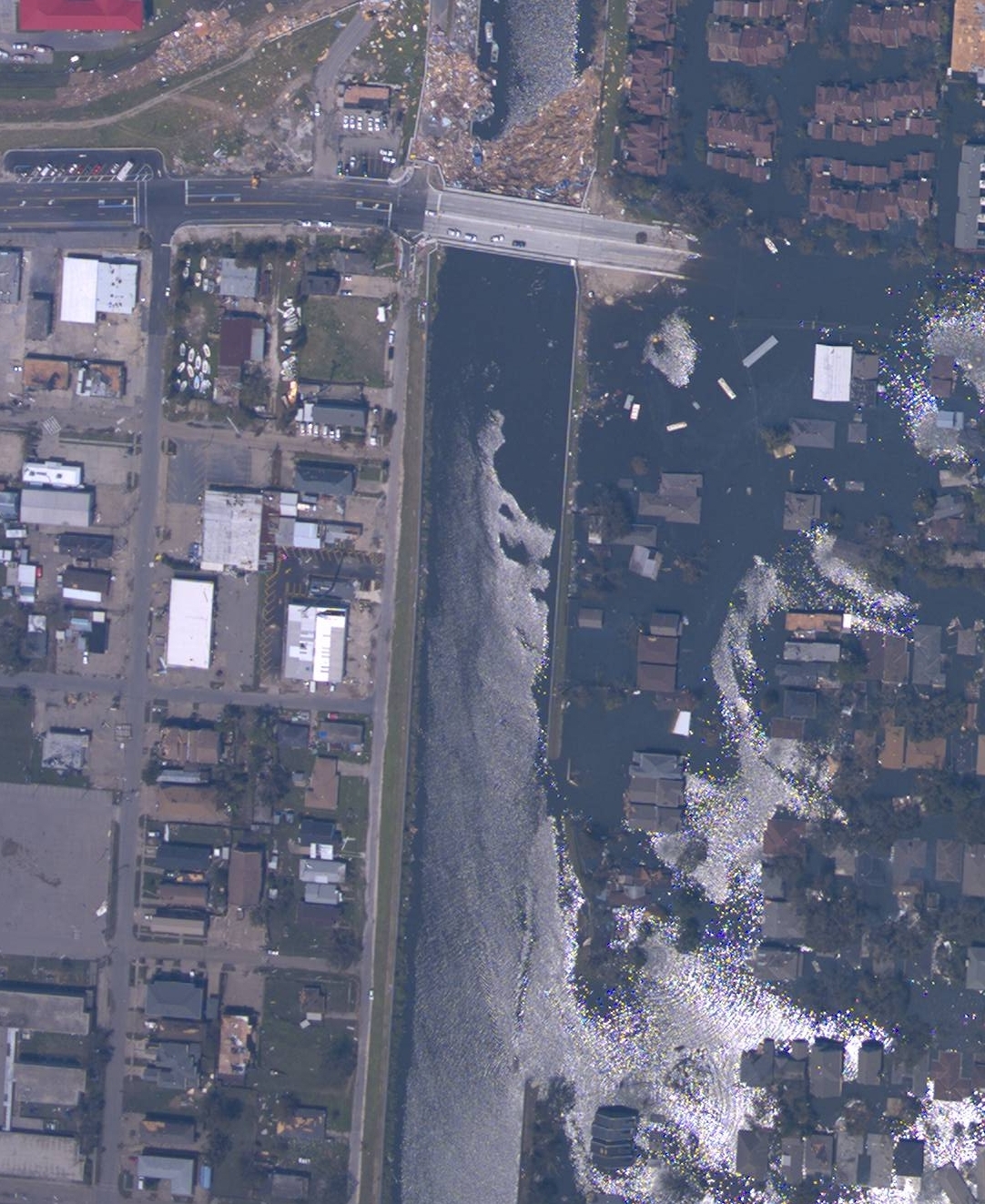
The live news coverage of Hurricane Gustav has included video from an NBC affiliate showing waves breaking over a levee on the Industrial Canal, an area where there were failures during Katrina. The MSNBC web site has a Reuters photo showing the area in a viewer that makes a link rather useless, but the BBC has an AP photo showing this area:

This is a great picture because it illustrates one of the main improvements made after Katrina. (It also shows that the surge is at treetop level in the canal.)

Analysis of the failures after Katrina by the American Society of Civil Engineers and the US Corps of Engineers showed that many levees failed even though the water level from the storm surge was below the top of the levee. Why?

The surge itself is not much more than a steady rise in the water level, although it can be as rapid as a flash flood on a river. This would be a static equilibrium problem familiar to any student of physics and calculus. [The force on the wall is found by multiplying the water pressure times the area of the wall. Since the water pressure increases with depth, you need to do an integral to add up the forces on the wall that try to push it sideways, or the torque that tries to rotate it about its base.] At least one wall failed during Katrina because its foundation was not strong enough to withstand those static loads even when the water was a foot or so below the top (as it is in this picture).

However, there are also dynamics at work here. The wind produces waves that pound on the wall and break over it. Water landing on the back side of the wall can erode the dirt holding the wall in place. Weaken that foundation, which resists the loads on the wall, and it can slide sideways or tip over, or both. Notice that the wall in this picture has a concrete footing, like a sidewalk, where the water will land if/when waves (or even the storm surge itself) go over the top of the wall. This dissipates the energy of the falling water, which can then run gently off down the sodded levee below rather than erode the base of the wall.

Imagine the difference between running a hose full blast on a sidewalk and running it on your garden or lawn for a day or two. The sidewalk will still be there, the garden will not. Now imagine it was a fire hose rather than a garden hose, and you will see the problem when Katrina drove 6 foot waves over a levee while the storm surge itself was still below the top of the levee.

PS -
Another picture from that same set shows the other side of a Weather Channel standup out in the storm. The secret to getting a steady shot of the reported being buffeted by the wind is to have a small camera man being held by what looks like a retired offensive lineman. I guess if you can bench press 400 pounds, you can hold onto anything in any wind!

Historical Context

Although this NOAA picture is not as clear as the news photo, this photo of a breach of a flood wall due to Katrina shows only grass, rather than a concrete roadway, on the back side of the wall. However, this wall was an outright engineering design failure of the foundation, not a result of overtopping. In the bottom half of the picture, you can still see the levee and floodwall that was pushed, intact, about 30 feet sideways into the Lakeview neighborhood by the water pressure. Metairie (on the left) was dry because water levels never reached the top of the wall.

I thought I should also point out that this famous picture does not show water pouring into the city as was frequently stated in the news. Anyone paying attention will notice that it shows water flowing back out of the city, into the canal! Water was flowing OUT of the flooded areas during the time they were desperately trying to close the breech in the levee with helicopters dropping giant sand bags, not in.


Read Entire Article......

Thursday, July 24, 2008

Question for Readers

I know this blog is sometimes read by bloggers who are engineers, including several women (some of whose blogs I have been reading off-and-on for a long time). I teach physics to future engineers and an eager, nervous new crop is showing up in a month or so. Many will not succeed.

What can I do to make a difference? What made a difference for you, or what do you wish you had learned when taking physics that you didn't figure out until later?

I wouldn't have mentioned women in the lead if the question wasn't partly about underrepresented groups in STEM areas. My classes at this CC often contain more minorities and women (as well as rural first-in-family men) than is the norm elsewhere. I remember being stunned one day in my Physics 2 class when I realized that white males were a minority. I know we have an impact, and not just in numbers: I know some of my female students have been extremely successful.

But I also know the physics classroom and lab is an alien environment. It helps that there are many more women around, but it is evident to me that they are more likely to face prejudices within their peer group than black students. (Mirror of misogyny meets racism in the Democratic primary season?) Part of this is the "boys talk authoritatively" problem mentioned in Saturday's blog.

Any advice?

I don't mind long comments, so feel free to "hijack" the thread. If you decide to blog about this instead, please post a link in the comments area so I will be sure to see it.


Read Entire Article......

Saturday, July 19, 2008

Hard to Believe / Easy to Relate to

Top 20 of all blogs on engineering? (on July 19) Hard to believe.


Doubt if it will stay there. I stumbled on this site ranking top engineering blogs while looking for something else. Although my appearance there makes me question its methodology and scope, it does have some interesting places listed there and I can see why I fit in. After all, most of the people I teach physics to are future engineers and (as a result of being related to engineers) lots of engineering topics and blogs come my way.

Boys talk authoritatively? Easy to relate to.

“The boys take over the hands-on projects and the girls take notes,” Eaton said. “Boys will answer a question more authoritatively. Girls pose answers as a question. They are not as confident in their answers.” (Quote from a newspaper article featured in a blog about a Beloit College program.)

This is a problem I have talked about before in my blog, and should think about more. For now ...

... I'll remind you that this important teaching-related point appeared at the very bottom of my article about teaching lab classes. The biggest problem I see in the lab is when a young man gives a highly authoritative answer that is 100% wrong and the young woman, who had much better physical insight into what should be done, goes along. Usually this doesn't show up until I see it in a lab report, which is a bit late for effective feedback.

I don't really have a simple solution, but the best one so far seems to be to watch how groups form (all female groups often work well, but individual personalities also matter) and monitor the lab group dynamics during the lab. I have also talked to some of the women after or outside of the lab about this issue.

One thing that does work is telling a favorite story in class about applying knowledge to a new situation, where the heroine is a former student (now an engineer). I knew (and told her so) that one young woman was definitely going to make a great engineer when she told me about an experience the previous weekend. She had been helping her boyfriend work on his truck, but they had run into a problem: the timing mark was gone. She realized that she could measure the circumference of the wheel and use 10/360 to figure out the distance from "top dead center" to where the mark needed to be. !! Is there a better elementary example of a high level of critical thinking within the infamous Bloom's Taxonomy?

(Oh crap, now I have seen Bloom's Wheel. Until now I had only heard about it.)

And I keep adding to my list of such stories as I learn of the successes of my former students. One characteristic of a CC is that we do get the non-traditional student, some from rural areas where experiences like working on equipment can translate into real success in engineering once they develop the confidence that they can do it.


Read Entire Article......